Why St Petersburg Flood Zone Home Prices Split Apart
August 20, 2026
August 20, 2026
What if the flood zone letter on a St. Petersburg listing sheet is the least useful number on the page?
That is not how most buyers approach it. Ask around and you will hear the same shorthand everywhere: Zone X is safe, Zone AE means trouble, and waterfront neighborhoods simply cost more because they are waterfront. It is a tidy story, and in a city where the median single-family home sold for roughly $415,000 in the first quarter of 2026, according to Stellar MLS data, tidy stories are appealing.
They are also incomplete. The number actually splitting home values in half right now inside St. Petersburg's flood-prone neighborhoods is not the zone letter. It is a four-page survey document called an elevation certificate, combined with a construction rule the city enforces one percentage point stricter than the federal government requires. Two homes on the same street, in the same zone, built the same decade, can carry insurance bills and resale prices that look like they belong to different cities. The zone tells you the neighborhood. The certificate tells you the actual number.
Since FEMA rolled out Risk Rating 2.0, flood insurance premiums are calculated from the individual characteristics of a specific property rather than from the flood zone alone. Elevation above base flood elevation, distance to open water, and construction type all move the number independently of whatever letter is printed on the FEMA map.
That is why an elevation certificate, typically costing somewhere between $400 and $900 for a standard residential property, has become one of the more consequential documents in a Tampa Bay real estate file. A certificate that documents a home sitting even a foot or two above base flood elevation can cut a flood premium by 15 to 30 percent per foot, often paying for itself within a matter of months. A home in the same zone without one gets rated conservatively, as if it were at grade.
An unremarkable-looking survey can be the difference between a flood premium near $800 a year and one closer to $2,400.
That gap compounds every year a buyer owns the home, and it shows up again the day they sell, because the next buyer's lender will ask for the same document.
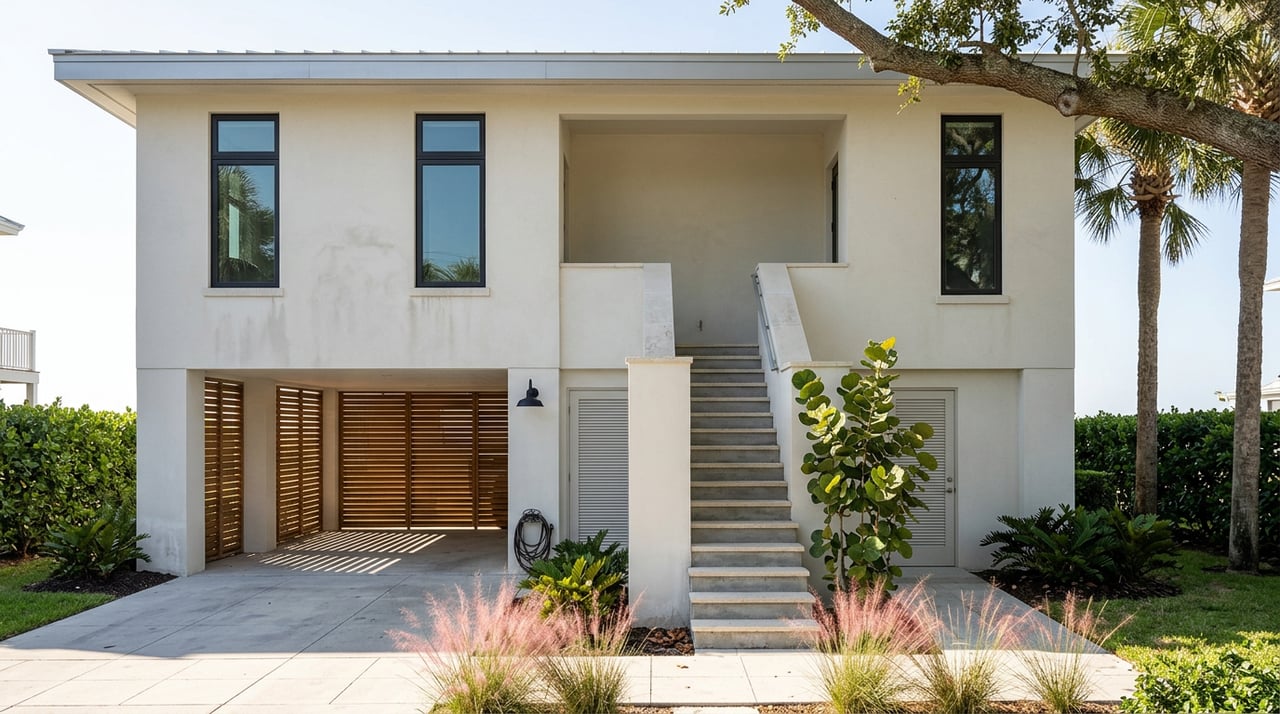
Nowhere in St. Petersburg makes this clearer than Shore Acres, the roughly 2,400-home peninsula neighborhood built on filled land between Tampa Bay and Coffee Pot Bayou. The neighborhood sits two to seven feet above sea level and is almost entirely in FEMA's AE flood zone. Hurricanes Helene and Milton flooded more than 80 percent of Shore Acres homes in the space of a few weeks in late 2024, some under six feet of water during Helene's record storm surge. As of mid-2026, some properties in the neighborhood remain in active remediation.
That history shows up in the sales data as a single median that hides two very different markets. Shore Acres sales in spring 2026 clustered around a median of roughly $472,000 to $480,000, well off 2022 to 2023 peaks, with homes sitting on the market anywhere from about seven weeks to three months depending on condition and flood history. But that median is an average of two products being sold under one neighborhood name. Non-waterfront homes that still need renovation are trading in the high $400,000s. Elevated, code-compliant rebuilds on canals routinely clear $800,000, and newly built homes on pilings are pushing past $1.2 million, with some reaching $1.7 million.
Same neighborhood. Same flood zone. A gap wide enough to buy a second house.
The city is betting real money that this gap narrows over time. St. Petersburg has approved a stormwater pump station project for Shore Acres budgeted at roughly $32 to $33 million, the largest neighborhood-specific flood resilience investment in city history, with construction along Connecticut Avenue NE and Bayshore Boulevard NE scheduled to begin in fall 2026 and run about 20 months. Just this July, the city secured an additional $2 million in the state budget, part of a $3 million commitment across two fiscal years, specifically for the Denver Street storm damage improvements in the neighborhood.
None of that erases the math facing an individual homeowner today. A Congressional Budget Office analysis reported by WTSP found that lifting a home is roughly two and a half times cheaper nationally than paying repeat flood claims, and about six times cheaper specifically in Shore Acres. But the state's Elevate Florida grant program drew more than 12,000 applications and is expected to approve only around 2,000. Locally, the Shore Acres Civic Association has estimated that only about a quarter of the neighborhood's roughly 480 applicants will receive help. Most owners who elevate are financing it themselves, which is exactly why the certificate that proves it becomes such valuable paper.
Shore Acres is the sharpest example, but the pattern holds across the city. Here is how five St. Petersburg neighborhoods compared in Stellar MLS data through the first quarter of 2026, with Disston Heights added from Redfin's March 2026 figures for context.
| Neighborhood | Median Sale Price | Days on Market | Flood Context |
|---|---|---|---|
| Snell Isle | $920,000+ | 28 | Waterfront AE zone; flood insurance is a real line item even at this price point |
| Old Northeast | $625,000 | 22 | Mostly minimal flood risk; brick streets and walkability carry the premium |
| Shore Acres | $480,000 (blended) | 35 (citywide avg; individual sales range 50-95) | Entirely AE; elevated homes and non-elevated homes sell as if in different markets |
| Historic Kenwood | $365,000 | 19 | Strong appreciation; arts district proximity driving demand |
| Disston Heights | $370,800 (Redfin, March 2026) | 52 | Entirely Zone X, 30 to 60 feet above sea level; no lender-required flood policy |
| Allendale | $310,000 | 24 | Minimal flood risk; steady entry-level demand |
Notice that Disston Heights, sitting entirely in Zone X on some of the highest ground in Pinellas County, lands within a few percent of Historic Kenwood's price despite carrying none of the AE-zone insurance mandate attached to Snell Isle or Shore Acres. Notice too that Snell Isle, itself an AE zone, still commands the highest median in the table. Waterfront location clearly still buys a premium. What it does not automatically buy is a flood policy priced like Disston Heights. That gap gets negotiated separately, one elevation certificate at a time.
For buyers eyeing a fixer-upper in Shore Acres, Venetian Isles, Snell Isle, or the flood-zone pockets of Coquina Key and Jungle Prada, there is a second mechanism worth understanding before making an offer. FEMA requires that once a permitted renovation reaches 50 percent of a structure's pre-improvement market value, the entire building must be brought up to current flood code, effectively meaning it has to be elevated. St. Petersburg enforces that threshold at 49 percent instead, one point tighter than the federal default, and it counts cumulatively across a rolling 12 months rather than resetting with each permit.
That means a kitchen remodel two years ago and a bathroom addition this year can combine to trip the threshold on a project that never intended to touch the foundation. It is the kind of detail that changes a renovation budget from a five-figure project into a full rebuild, and it is exactly the sort of thing a buyer's inspection team should be asking about before writing a contract on any older home in one of these flood zones.
A few habits separate buyers who navigate this smoothly from the ones who get a number at the closing table they were not expecting.
Ask the seller for the home's existing elevation certificate before you write an offer, not after. If one does not exist, budget for ordering your own during due diligence and build the timeline into your contract. Get an independent flood insurance quote on the specific address, not a neighborhood average, before any contingency deadline passes. If you are considering a home that has already had work done, ask what percentage of its market value that work represented, since a well-meaning previous owner may have already used up most of the room the 49 percent rule allows. And if a seller mentions a grandfathered pre-FIRM flood policy, that detail is worth documenting and asking whether it can transfer, because those older policies sometimes carry meaningfully lower premiums than anything available to a new buyer today.
Does Flood Zone X mean I will never need flood insurance? No. Zone X means a mortgage lender will not require it, but a meaningful share of flood claims nationally still come from properties outside the mapped high-risk zones. Many Disston Heights and Historic Kenwood owners still carry a low-cost optional policy for exactly that reason.
Who actually orders an elevation certificate, and who pays for it? Either party can. Some sellers order one ahead of listing because it strengthens the sale story on a flood-zone home. Buyers who do not have one from the seller typically order their own during due diligence, since the cost is modest compared to what it can save on the insurance quote that follows.
Is Shore Acres a bad place to buy right now? That depends entirely on the specific property and on a buyer's own financial picture, and it is worth talking through with both a real estate professional and a licensed insurance agent rather than deciding from a neighborhood-wide headline. What the data shows is a market currently pricing elevated and non-elevated homes very differently, with a large public infrastructure investment underway that will not be finished for a while. Those are facts to weigh, not a verdict.
Flood zones and insurance costs are part of the financial picture of owning property in St. Petersburg, and this piece is meant to inform that picture, not to substitute for advice from a licensed insurance agent, surveyor, or attorney on your specific address.
If you are trying to figure out what a specific St. Petersburg address actually costs to insure, or whether a home you are considering has ever had its elevation documented, that is exactly the kind of digging Kim Guillory does before a client ever writes an offer. Let's Get You Home.
Stay up to date on the latest real estate trends.

Get assistance in determining current property value, crafting a competitive offer, writing and negotiating a contract, and much more. Contact me today.